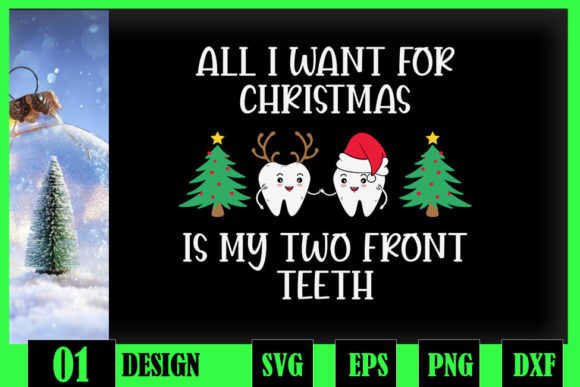
All I Want for Christmas is Front Teeth
A Designer’s First Look: Playful, Punchy, and Perfectly Sized for Real Stitching
As someone who’s stitched hundreds of holiday designs—from delicate snowflakes to sprawling Santa scenes—I opened All I Want for Christmas is Front Teeth expecting whimsy. What I got was something sharper: a tight, cleverly balanced composition that lands like a wink from a toddler who just lost their two front teeth mid-carol. The layout feels intentional—not crowded, not sparse—with clean letterforms and a subtle visual rhythm that suggests movement (like a grin spreading). It’s clearly built for embroidery, not just print: the spacing between letters avoids awkward stitch jumps, and the implied “gap” where those front teeth would be reads instantly, even at small sizes. This isn’t just a graphic—it’s a machine embroidery design with personality baked into its structure.
How It Actually Stitches: From Tote Bag to Tea Towel
Last week, I prepped a batch of organic cotton tote bags for a local boutique’s holiday pop-up—and All I Want for Christmas is Front Teeth was my test candidate. Hooped on medium-weight tear-away stabilizer, stitched in matte polyester thread on a 4-inch hoop, it held up beautifully. The lettering stayed crisp, no skipped stitches or thread breaks. On sweatshirts? Yes—especially lighter fleece blends—just add cutaway stabilizer underneath to prevent puckering. For baby onesies or burp cloths, I’d size it down to 3.2 inches wide and use soft, low-density fill stitches to keep it breathable and gentle. As a patch? Ideal. The clean outer edge and minimal interior detail mean it’ll hold shape after heat-sealing or sew-on application. Even on curved surfaces like structured caps, the compact width and centered baseline helped me avoid distortion—no stretching or re-hooping needed.
Where It Shines—and Where You’ll Want to Pause
This design excels in contexts where charm and clarity matter more than formality: personalized gifts (think embroidered pillow covers for a new parent), holiday aprons for bakers, tea towels for a quirky kitchen shop, or baby milestone blankets. Its voice fits Etsy sellers and craft fair vendors who lean into lighthearted, relatable storytelling. That said, tread carefully on thin or highly textured fabrics—like linen napkins or slubbed canvas—where fine letter details might blur. Avoid using it full-size on stretchy knits without proper stabilizing; the satin-stitch edges can pull if the base fabric gives too much. And while the design works on dark fabric, test contrast first: light thread on black fleece needs slightly higher stitch density to avoid “ghosting,” and white thread on navy cotton can look softer than expected in natural light.
What It Adds to Your Finished Product—Beyond the Stitch
All I Want for Christmas is Front Teeth does more than decorate—it invites interaction. Customers smile, then pause. They get it. That micro-moment of recognition builds trust in your handmade product. For small shop owners, it reinforces brand consistency when paired with other playful, well-executed holiday embroidery files. For digital product sellers, it’s a strong anchor in a Graphics bundle: versatile enough for printable mockups, SVG-based web previews, or layered embroidery project kits. Most importantly, it elevates giftability. A tote bag with this stitched front-and-center doesn’t feel mass-produced—it feels chosen, thoughtful, and human. That emotional resonance translates directly to buyer engagement, repeat orders, and word-of-mouth referrals.
Practical Notes Every Embroidery Designer Should Check Before Stitching
- Test first—always run a sample on scrap fabric matching your final product’s weight and stretch.
- Review stitch density—if your machine defaults to high-density fills, soften them slightly for baby items or lightweight apparel.
- Confirm hoop size—this design fits comfortably in a 4x4 hoop, but double-check the actual dimensions in your embroidery software before resizing.
- Inspect small details—especially the inner curves of the “O”s and the negative space between “Front” and “Teeth.” These define the design’s wit.
- Mock it up in black and white—to assess legibility on both light and dark backgrounds before committing thread.
- Use appropriate stabilizer—tear-away for stable wovens, cutaway for knits, and lightweight fusible for delicate baby fabrics.
- Verify licensing—since this is a digital embroidery file sold as a Crafts asset, confirm whether commercial use (e.g., selling finished embroidered totes) is permitted before listing on Etsy or at craft fairs.
Final Thought: A Design That Earns Its Smile
All I Want for Christmas is Front Teeth isn’t trying to be everything. It’s focused, friendly, and functionally smart—a rare combo in holiday embroidery. It doesn’t overwhelm. It doesn’t under-deliver. It stitches cleanly, reads instantly, and carries warmth without leaning into cliché. Whether you’re building a cohesive line of nursery decor, stocking a holiday booth with custom apparel, or adding personality to your small shop’s merchandise, this design earns its place—not because it’s trendy, but because it’s trustworthy. In the world of digital embroidery files, that kind of reliability is the real gift.